
Written by
Posted on
24 September, 2026
 Copy link
PSLE Composition: How Content and Language Marks Are Awarded
If your child is preparing for the PSLE, you’ve probably asked this question at some point: where do the marks actually come from? Your child may write a full story, use interesting vocabulary, and still receive a mark that feels lower than expected. So what exactly are markers looking for?
Understanding how PSLE composition marks are awarded can make practice much more useful. Instead of simply telling your child to “write better”, you can identify whether the main issue lies in the story itself or in the way your child uses language.
This article focuses specifically on how the composition is assessed. It doesn’t cover how your child should divide their time during the examination. If you’re looking for help with pacing and planning during Paper 1, our separate time management guide covers that side of PSLE English preparation.
For now, let’s look at where those composition marks actually come from.
The Two Assessment Components
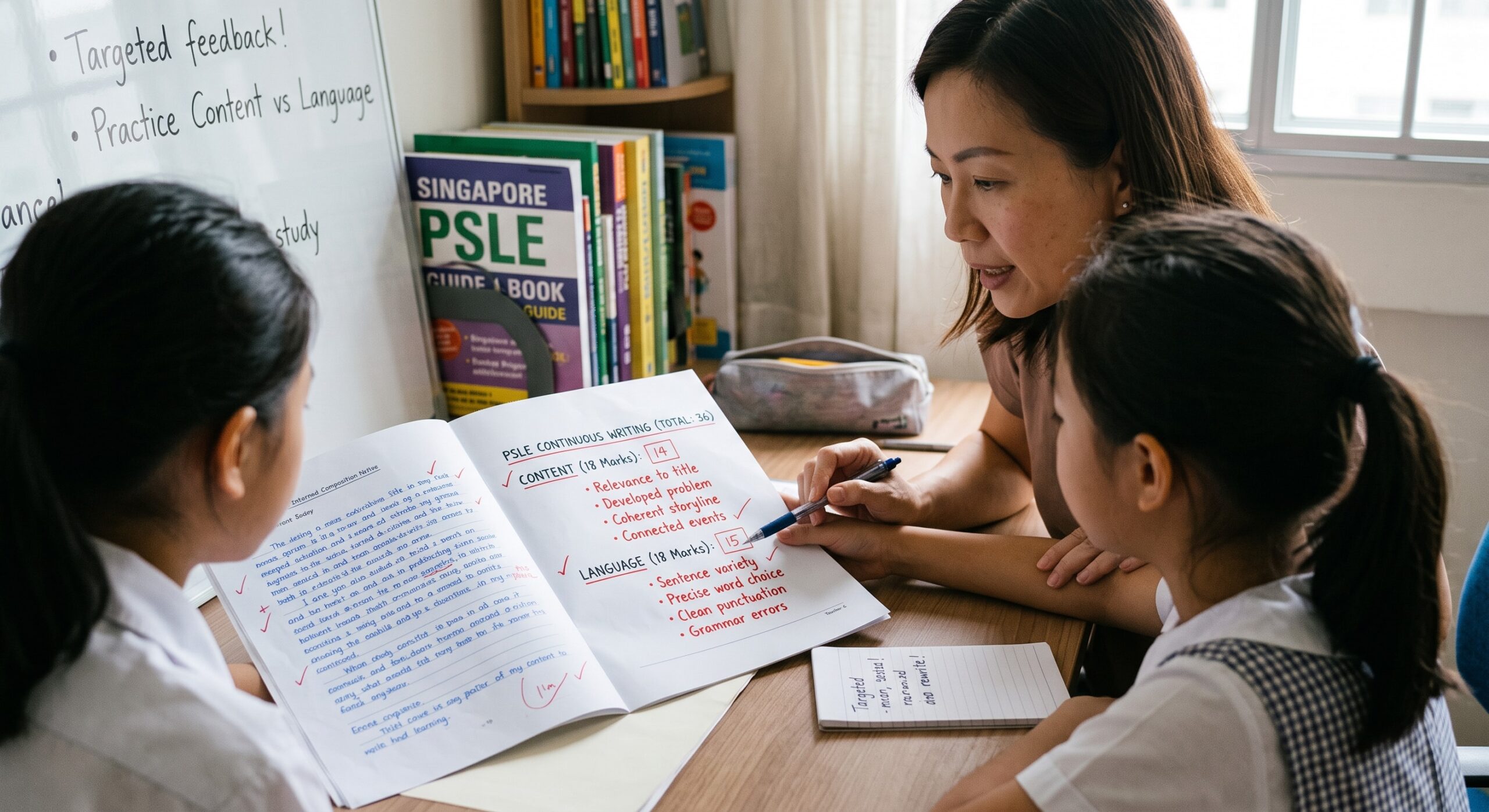
The PSLE Continuous Writing component carries 36 marks. It is assessed through two main areas: content and language, with 18 marks for each.
Content
Content looks at how well your child responds to the given topic and develops the story. This includes things such as:
- Staying relevant to the given title
- Developing ideas instead of simply listing events
- Building a clear and connected storyline
- Creating a problem and developing what happens around it
- Bringing the story to a suitable ending
Your child doesn’t need the most unusual story to score well. A simple idea can work if they develop it clearly and keep the whole composition connected to the topic.
Language
Language assesses how effectively your child conveys the story. This includes:
- Grammar
- Vocabulary
- Sentence variety
- Spelling
- Punctuation
The two areas need different skills. A child can have a strong storyline but lose language marks through repeated grammar errors. Another child may write accurate sentences but lose content marks because the story doesn’t develop.
Markers also don’t simply count individual mistakes and add up the marks. They consider the overall quality of the piece and place it within the appropriate performance band before determining the mark within that range.
That means one or two mistakes don’t automatically ruin an otherwise strong composition. What matters is the quality and consistency of the writing as a whole.
What Pushes a Composition Into a Higher Band
So, what does stronger writing actually look like?
On the Content side
A clear connection to the title from the start.
Your child shouldn’t write a general story and only connect it to the given topic in the final paragraph. The title should shape the story from the beginning.
A problem that genuinely develops.
If the main problem appears and gets solved in one sentence, there isn’t much for the reader to follow. A stronger composition shows what happens as a result of the problem, how the character responds, and how the situation changes.
An ending that follows from the story.
The final paragraph shouldn’t feel like something your child added because they ran out of time. A good ending grows from what happened earlier and brings the main problem to a clear close.
The story also needs to stay coherent. Each event should have a reason for being there, rather than simply moving from one incident to another.
On the Language side
Sentence variety.
Your child doesn’t need to make every sentence long. In fact, doing so can make the writing harder to follow. Stronger writing uses a mix of short and long sentences, depending on the moment.
A short sentence can create impact during an important moment. A longer sentence can slow down a description or show how several events connect.
Precise word choice.
Using impressive words isn’t the same as using language well. A familiar word that fits the situation can be more effective than a difficult word that sounds forced.
Encourage your child to choose words that express exactly what they mean.
Clean punctuation.
Punctuation matters because it affects how clearly the reader can follow the writing. Dialogue is one area where children often make avoidable mistakes, especially with quotation marks, commas, and full stops.
What Pulls a Composition Down
Some problems recur in practice compositions.
Drifting off the title after a strong opening. Your child may begin with a promising connection to the topic, then move into a familiar story that could fit almost any title. Once that happens, the content becomes weaker even if the writing itself sounds good.
Describing all the given pictures instead of building one story. The pictures give your child ideas. They don’t require your child to describe every detail shown in them. The stronger approach is to choose an idea they can develop into a single connected story while ensuring the composition meets the task requirements. For the current PSLE Continuous Writing format, the composition must be based on at least one of the three pictures.
A rushed final paragraph. If the ending suddenly becomes very short, the problem may have started much earlier. Your child may have spent too long on the introduction or included too many unnecessary events.
Repeated sentence openers. If every sentence begins with “Then”, “After that”, or “Suddenly”, the writing can quickly become repetitive. Your child needs enough control over sentence structure to move between ideas more naturally.
Memorised phrases that don’t fit. Memorising useful vocabulary or expressions isn’t necessarily a problem. The issue starts when your child forces them into a story simply because they remember them.
How to Use This When Reviewing Practice Papers
You don’t need to become a marker to give useful feedback at home. Look at content and language separately. Is the story relevant, developed, and complete? Then check for repeated sentence patterns, grammar, spelling, punctuation, and tense errors. Once you spot the weaker area, focus on one criterion in the next composition. Then rewrite one weak paragraph rather than the whole piece.
This is how we approach composition writing at The Writer’s Place. Targeted feedback helps children understand what needs work and improve one skill at a time.
Conclusion
PSLE composition marks come from two places: content and language. They overlap in a good piece of writing, but they need different types of practice. If your child’s story is well developed but the language contains frequent errors, more plot ideas won’t solve the problem. If the grammar is accurate but the story doesn’t answer the topic, vocabulary drills won’t fix it either.
The good news is that these criteria aren’t a matter of natural talent. Your child can learn how to respond to a title, develop a storyline, control sentence structure, and improve language accuracy through regular practice and useful feedback.
If you’re preparing a Primary 6 child for the PSLE, we can help you identify which part of their writing needs the most attention and build practice around that specific gap.
Frequently Asked Questions
How is PSLE composition marked?
The PSLE Continuous Writing component carries 36 marks. The marks are divided equally between content and language, with 18 marks for each. Content focuses on how well your child responds to and develops the topic, while language covers how accurately and effectively they express their ideas.
Does my child have to use all three pictures?
No. Your child doesn’t need to use all three pictures. The current PSLE Continuous Writing task requires the composition to be based on at least one of the three pictures. The pictures provide possible directions for the story rather than a single fixed storyline.
Is creativity or grammar more important in PSLE composition?
Neither should be treated as more important. Content and language each carry 18 marks, so both matter. A creative idea won’t compensate for consistently weak language, while grammatically accurate writing won’t automatically score highly if the story doesn’t develop or stay relevant to the topic.
How many words should a PSLE composition be?
Your child must write at least 150 words for the Continuous Writing component. The 150-word requirement acts as a minimum, but your child should focus on writing a complete, relevant, and well-developed story rather than trying to reach an arbitrary word count.
Can composition marks improve in one year?
Yes. A year gives your child meaningful time to identify specific weaknesses, practise them, receive feedback, and apply what they’ve learnt. The key is targeted practice. Writing more compositions without understanding why marks are lost may not yield the same improvement as focused work on content, language, or both.
Ready to see your child shine in writing?
Enrol now and start building your child’s English and writing foundation, or take our free assessment to discover how we can help.