
Written by
Posted on
23 September, 2026
 Copy link
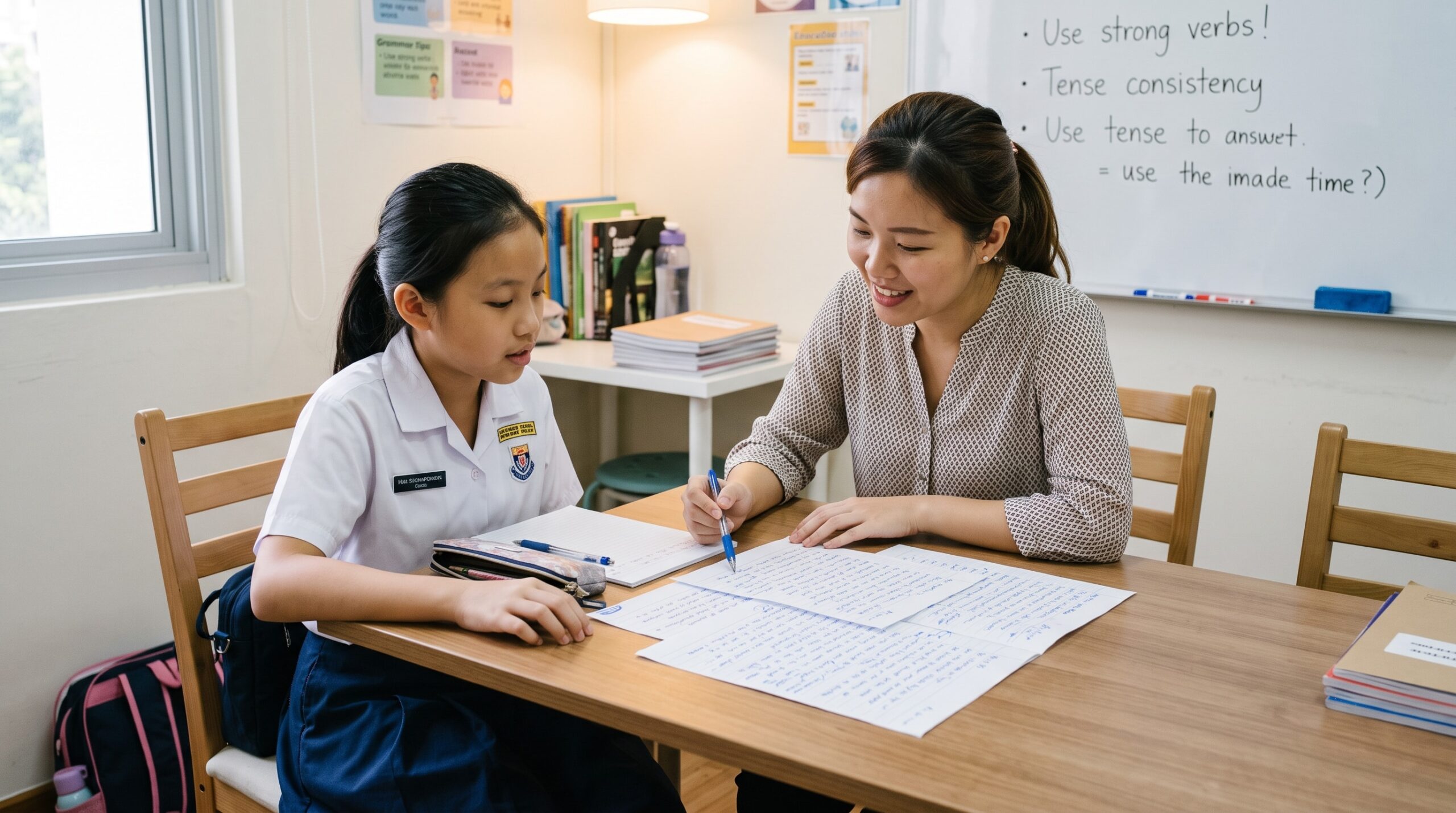
Primary 5 Writing: Why PSLE Preparation Really Starts a Year Early
A common plan sounds reasonable: get through Primary 5, then focus properly on English in Primary 6. After all, the PSLE is still a year away. There’s plenty of time to work on writing, right?
The problem is that Primary 6 is usually not the best time to start building basic writing skills. By then, your child has to manage revision, school assessments, other subjects, and the growing pressure of the PSLE. There’s less time to stop and work out why a composition keeps going off track.
That’s why creative writing for Primary 5 matters. P5 gives your child a full year to build the skills they’ll need for PSLE English, rather than trying to fix everything when the exam is just around the corner.
What Primary 5 Is Really For
Primary 5 is an important transition year for writing. Your child is no longer simply learning how to write a complete composition. They need to handle a longer piece with a clearer storyline, stronger development, and more consistent language. The standard also becomes less forgiving when small mistakes begin to affect the overall quality of the writing.
A child may have good ideas but struggle to organise them. Another may write a complete story but make frequent tense or punctuation errors. Some children can write well when they have plenty of time, but struggle when they have to plan, write, and check their work within a fixed period.
These are exactly the areas worth identifying in P5.
Instead of asking whether your child is “good” or “bad” at English, look at what happens when they write.
- Can they plan without getting stuck?
- Can they develop a problem rather than list events?
- Can they keep their tenses consistent?
- Can they finish with enough time to check their work?
P5 gives you time to answer those questions and work on the gaps.
Why Leaving It to Primary 6 Is Difficult
Primary 6 needs to be about revision and practice. It becomes much harder to spend months building a skill from the beginning. Imagine a child entering P6 without a reliable planning method. Every composition starts with the same question: “What should I write?”
They may spend too long thinking of an idea, rush the middle of the story, and then have little time left to check their language. More practice alone won’t necessarily solve the problem if the child hasn’t learnt how to plan and control the writing process.
The P6 schedule also gets crowded. Your child has schoolwork, tests, revision, and preparation across several subjects. Adding a completely new writing routine at this stage can make English feel like another problem to solve. That’s why it helps to use P5 to build the foundation.
By the time P6 begins, your child should not still be figuring out how to plan a story. They should use a planning method they already know, then refine it through practice.
The Four Skills to Lock In During Primary 5
1. A planning routine
Your child should have a simple planning routine they can use without waiting for an adult to tell them what to do. They should know how to read the title, identify what the story needs, choose an idea, and outline the main events before they start writing.
2. Control of pacing
A strong composition isn’t only about having a good idea. Your child also needs to know how much time to spend on each part. If they spend too long on the introduction, they may rush the main problem. If they write too quickly, they may miss details or make avoidable mistakes.
3. Accuracy under time pressure
Grammar, tenses, punctuation, and sentence structure can look fine when your child writes slowly at home. The challenge comes when they have to write under a time constraint. Regular practice helps your child notice the mistakes they tend to make when they rush. Once those patterns become familiar, they can start checking for them more naturally.
4. A range of adaptable plot ideas
Your child doesn’t need to memorise dozens of stories. Instead, they should have enough familiar situations and plot ideas to avoid panicking when a title looks unfamiliar. They need to know how to adapt an idea to the question rather than forcing the same story into every composition.
What Progress Looks Like Over a P5 Year
P5 doesn’t need to feel like one long countdown to the PSLE. It can follow a steady progression.
Term 1: Find the real gap
Start by looking at Content and Language separately. Does your child struggle to develop the story, stay on topic, or create a clear ending? That points towards a Content issue.
Or does the story work, but the writing contains frequent grammar, tense, spelling, or punctuation mistakes? That points towards a Language issue. Knowing which area needs attention makes practice much more useful.
Term 2: Build the missing skill
Once the main gap is clear, work on it deliberately. If planning is the problem, practise planning. If your child rushes through the middle of a story, work on developing the problem and its consequences. If language accuracy drops under pressure, practise writing within a set time and review the mistakes afterwards.
Feedback matters here because your child needs to know what to improve, not simply whether the composition is good or bad.
Term 3 and 4: Consolidate
By the second half of P5, the focus can gradually move towards applying those skills under greater time pressure. Your child should become more comfortable planning quickly, developing a story, controlling their pace, and checking their work before time runs out.
Conclusion
The simplest way to think about it is this: P5 builds, P6 refines.
Starting later doesn’t mean your child can’t improve. There is still plenty that can change with focused practice. The key is knowing what needs work and giving your child enough time to build the skill properly.
If you’re wondering whether your child is on track for P6, start by looking at their writing now. Where do they get stuck? What mistakes keep appearing? What happens when they have to write within a time limit?
Those answers can tell you much more than a single composition mark. If you want to understand where your child currently stands, we can help you identify the writing skills they should focus on during P5 and what they can work towards before P6.
Frequently Asked Questions
When should my child start preparing for PSLE English?
Primary 5 is a good time to start preparing seriously for PSLE English, particularly for writing. It gives your child time to identify gaps, build reliable writing habits, and practise applying those skills before P6.
Is Primary 5 too late to start writing classes?
No. Primary 5 still gives your child a full year to strengthen their writing before the PSLE. The important thing is to focus on the skills they actually need rather than simply increasing the number of compositions they write.
How much does composition matter in PSLE English?
Composition is part of Paper 1 of the PSLE English examination, so it plays an important role in your child’s overall English result. Your child needs to manage both the content of the composition and the accuracy of their language.
My child scores well in school, but I am worried about PSLE. What should I check?
Look beyond the overall mark. Check whether your child can plan independently, develop a complete storyline, stay focused on the topic, control their pace, and maintain accurate grammar, tenses, and punctuation when writing under time pressure. These areas can indicate whether their current skills are sufficiently stable to meet the demands of P6.
Ready to see your child shine in writing?
Enrol now and start building your child’s English and writing foundation, or take our free assessment to discover how we can help.