
Written by
Posted on
22 September, 2026
 Copy link
Why Primary 3 Is the Year Composition Suddenly Gets Harder
Your child was doing fine in Primary 2. They could write a simple story, complete their work, and get decent marks. Then Primary 3 starts, and suddenly their composition marks drop. You may wonder what changed. Has your child become weak in English? Do they need more vocabulary? Should they start writing more compositions at home?
In many cases, the problem isn’t ability. Creative writing for Primary 3 introduces a new level of thinking. Your child now needs to build a story, develop a problem, and stay focused on a given topic instead of simply describing what happens.
Once you understand what has changed, the drop in marks becomes much easier to explain.
What Actually Changes Between Primary 2 and Primary 3
In lower primary, children often work with picture sequences that give them most of the story. They can follow what they see, describe the events, and connect them in order.
Primary 3 asks for more. The pictures may no longer show the whole story. Your child has to fill in the gaps, decide what happens next, and create a proper ending. More importantly, they need to build a story around a given title.
That means your child needs to think about:
- What is the problem?
- What happens because of it?
- How does the character respond?
- How does the problem get solved?
This is different from simply writing well. A child may know plenty of words and write grammatically correct sentences but still lose marks if the story doesn’t develop or drifts away from the title. The shift can feel sudden because your child has gone from describing a story to building one.
Why Good Readers Can Still Struggle
Reading widely gives your child vocabulary, sentence patterns, and a sense of how stories work. But reading alone doesn’t always teach them how to plan and build their own story. Storytelling is a skill that many children haven’t had to use deliberately before Primary 3.
A child may read confidently and write fluent sentences, yet still struggle to decide what should happen in the middle of the composition. They may also start with an interesting idea, then move further and further away from the title.
This is why creative writing for primary school needs to cover more than vocabulary. Your child needs to learn how to turn ideas into a complete, relevant story.
The Three Signs Your P3 Child Needs Support
1. They take more than ten minutes to start writing
If your child spends a long time staring at the paper, they may not know how to turn the pictures and title into a story.
2. Their story is a list of events
They may write, “He went there. Then this happened. Then they went home.” The events are there, but there is no real problem, build-up, or resolution.
3. Every composition follows the same plot
If every story involves the same type of problem, ending, or character, your child may be relying on a single familiar storyline instead of adapting to the question at hand.
These signs don’t mean your child can’t write. They usually mean they haven’t learned the structure they now need.
What You Can Do at Home This Term
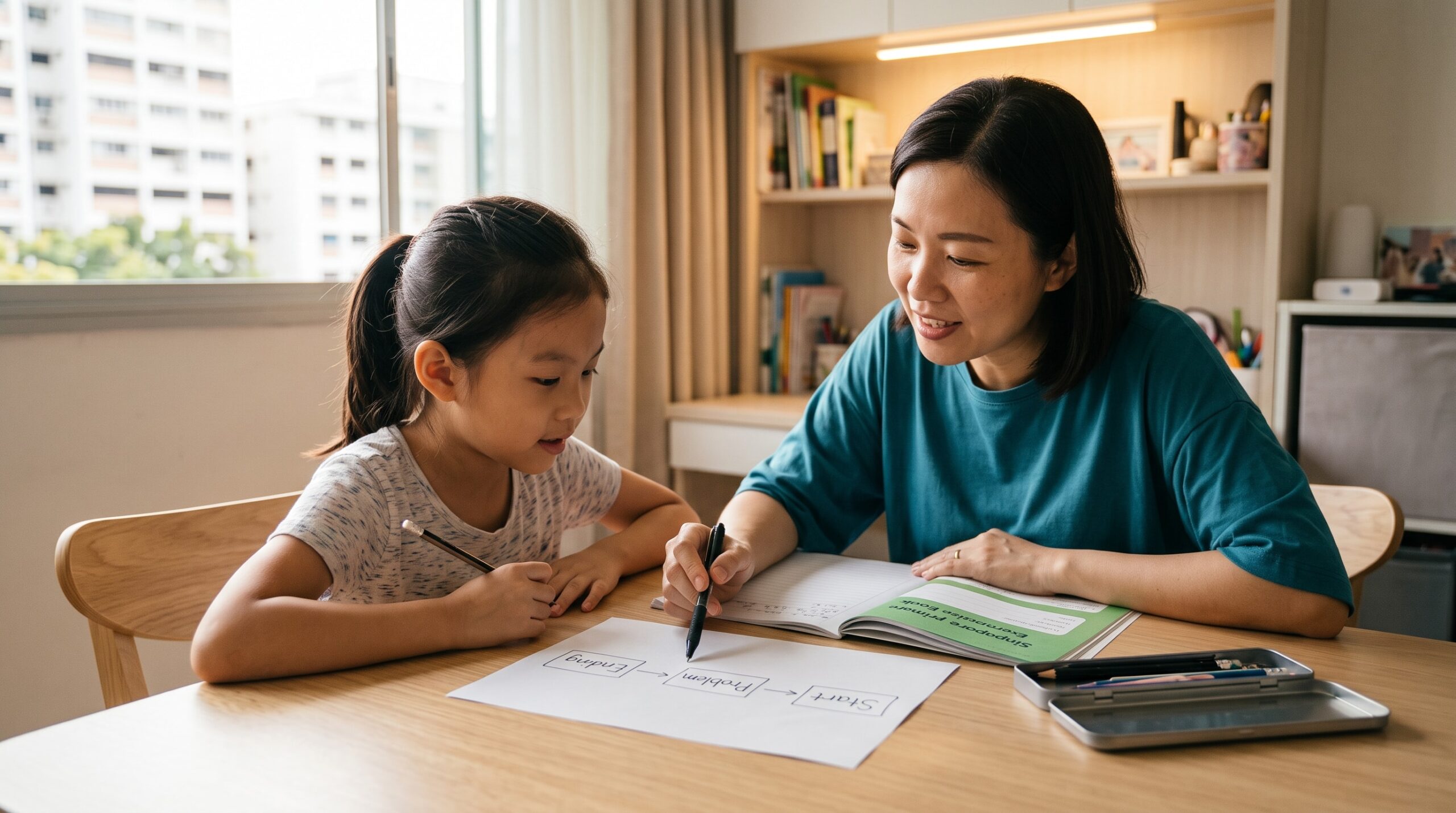
You don’t need to turn every evening into a writing lesson. Before your child starts writing, ask them to tell you the story in three sentences:
- What happens at the start?
- What is the main problem?
- How does it end?
This simple routine helps your child think about the whole story before they start writing.
When you review their work, focus on one improvement at a time. If the story has a weak ending, strengthen it. If the main problem isn’t developed, focus on that. Correcting every grammar, spelling, vocabulary, and punctuation mistake at once can make the task feel overwhelming.
You can also read a short story together and ask, “What was the problem?” and “How did the character solve it?” The goal isn’t to test vocabulary. It’s to help your child notice how a story moves from a problem to a solution.
How Structured Lessons Bridge the Gap
At The Writer’s Place, we don’t expect children to pick up story structure by reading more or writing more. We teach it directly.
In Primary 3, children learn how to build and develop a story, respond to a title, and connect their ideas so the composition feels complete. We also use games and activities to practise these skills without making every exercise feel like another graded piece.
This matters because Primary 3 sets the foundation for the years ahead. Once your child learns how to develop a problem, organise events, and stay focused on a topic, they have a stronger base for the more demanding compositions in Primary 4, Primary 5, and Primary 6.
Conclusion
If your child’s composition marks suddenly drop in Primary 3, don’t assume they’ve become weak in English. The bigger change may be the writing task itself. Your child now needs to move beyond describing events and start making decisions about the story.
With the right structure and practice, most children can settle into this new way of writing. The earlier they learn the skill, the easier it becomes to build on it in the later primary years.
If you’re looking for a more structured approach, explore how our Primary 3 programme helps children make this transition and build the writing skills they need for the years ahead.
Frequently Asked Questions
Why did my child’s composition marks drop in Primary 3?
Primary 3 often introduces more demanding story-building skills. Your child may now need to develop a problem, stay focused on a title, and create a complete storyline rather than describe a sequence of events.
Is Primary 3 too early for writing classes?
Not necessarily. Primary 3 is an important stage because children begin to handle more complex composition tasks. Learning story structure at this point can give them a stronger foundation for the later primary years.
How is Primary 3 composition different from Primary 2?
Primary 2 writing often relies more heavily on picture sequences. In Primary 3, your child needs to make more decisions about the story, including how to develop the problem and connect the events to the given title.
How long does it take for a P3 child to improve?
It depends on the gap. Some children improve once they understand how to structure a story, while others need more regular practice. The key is to identify the specific problem and work on it consistently rather than simply doing more compositions.
Ready to see your child shine in writing?
Enrol now and start building your child’s English and writing foundation, or take our free assessment to discover how we can help.