
Written by
Posted on
25 September, 2026
 Copy link
Creative Writing or General English Tuition: Which One Does Your Child Need?
When your child struggles with English, the obvious next step might seem to be more English tuition. But what if their grammar and comprehension are fine, while composition is the part pulling their marks down? That changes the question.
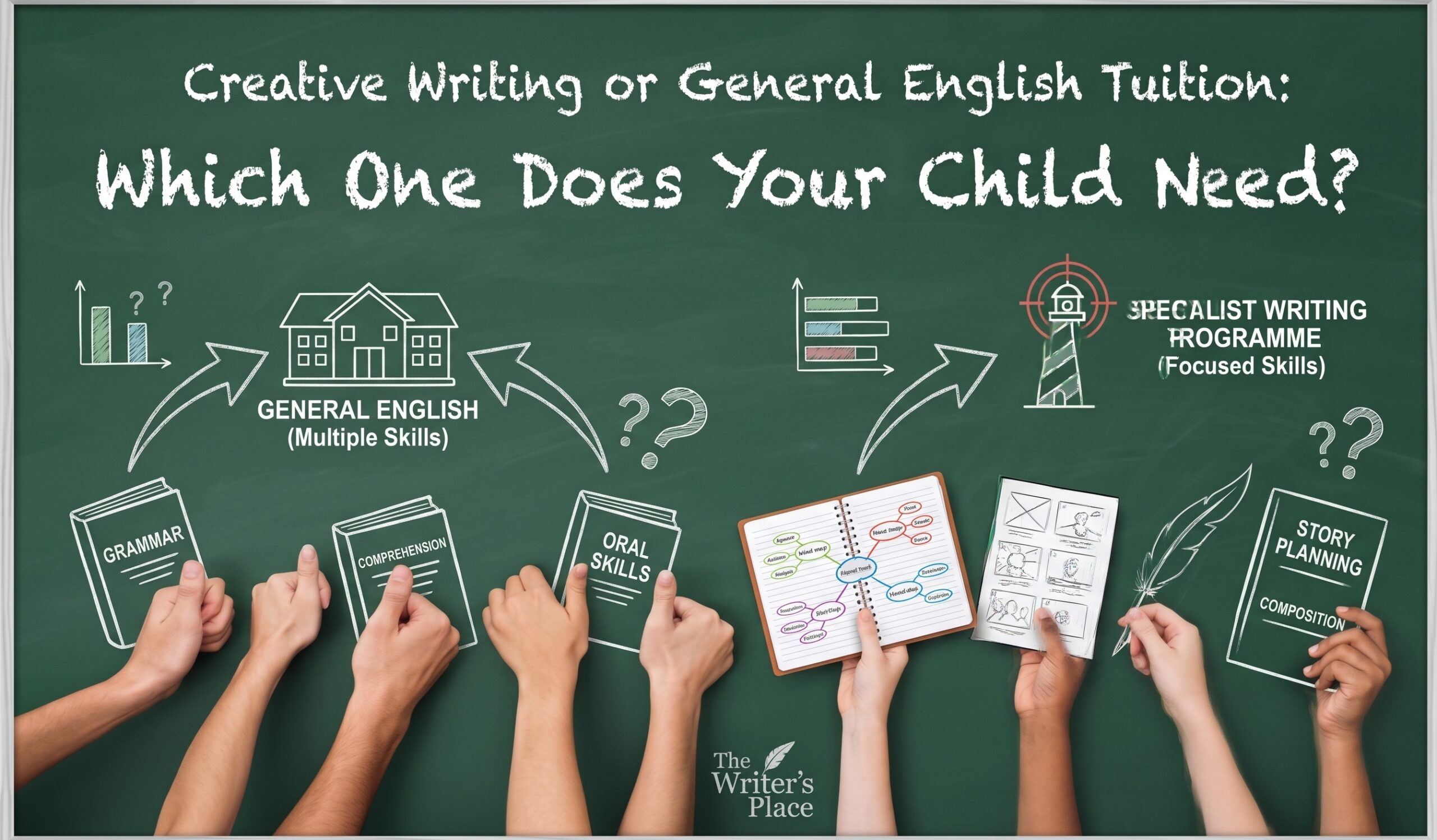
Instead of asking which centre is better, ask what your child actually needs help with. General English tuition and specialist writing programmes are designed to address different problems. One supports several parts of the subject, while the other focuses deeply on writing.
If you’re comparing English creative writing in Singapore programmes with general English tuition, your child’s results can help you decide which type of support makes more sense.
What a General English Programme Is Built For
A general English programme covers the subject as a whole. Lessons may include grammar, vocabulary, comprehension, oral skills, and writing. That broad approach can work well when your child’s difficulties extend across several areas.
For example, your child may struggle to understand comprehension passages, make frequent grammar errors, and find it difficult to organise ideas in writing. In that situation, working on the wider range of English skills makes sense.
The trade-off is that writing only receives part of the lesson. A child may practise composition, but they also need time for the other components. That means they may not get the same amount of focused writing practice as they would in a specialist programme.
What a Specialist Writing Programme Is Built For
A specialist writing programme takes the opposite approach. Instead of dividing lesson time across the English paper, it focuses on composition. That means your child can spend more time learning how to plan a story, organise events, develop a problem, add useful description, improve sentence structure, and revise their own work.
This can make a difference when your child’s other English skills are reasonably strong, but composition marks consistently lag. For example, your child may do well in comprehension and grammar but still:
- Take too long to decide how to start a composition
- Write a series of events without developing a clear story
- Struggle to build tension or describe important moments
- End the story abruptly because they run out of time
- Repeat the same sentence patterns or expressions
- Make the same writing mistakes across different compositions
These problems don’t always improve simply because a child writes more.
They often need targeted practice and feedback. When a child repeatedly works on the same writing skills, they get more opportunities to understand what went wrong, apply the feedback, and improve in the next piece.
That’s where specialist creative writing in Singapore can be useful for a child whose main weakness sits specifically in composition.
How to Tell Which One Your Child Needs
Before booking any programme, look at your child’s latest full English paper. Don’t just look at the overall mark. Compare the different components.
1. Look at the composition alongside the rest of the paper
If your child performs reasonably well in comprehension and grammar but receives noticeably weaker results for composition, that gap is worth paying attention to. It suggests that your child may not need more support across the entire English subject. They may need more focused help with writing.
2. If composition is the outlier, address the outlier
A child who understands grammar rules but cannot turn ideas into a complete story has a different problem from a child who struggles with grammar, comprehension, and writing. If composition is the weaker area, a specialist programme can target that specific skill rather than spreading the available lesson time across the whole subject.
3. If several components are weak, start broader
If your child’s difficulties appear across comprehension, grammar, vocabulary, oral, and writing, general English support may make more sense. Writing doesn’t happen in isolation. A child still needs a solid foundation in the wider language skills that support it.
4. Consider how much time you have
If your child has a long way to go and the exam year is approaching, focused practice can become more important. A specialist programme gives your child more time to work directly on composition skills, rather than dividing lesson time between several areas.
Can a Child Do Both?
Yes. Some children benefit from general English tuition alongside specialist writing support.
But before adding another class to the week, consider the workload.
Primary school children already have schoolwork, homework, revision, activities, and other commitments. More lessons don’t automatically mean faster improvement.
Instead of stacking programmes, consider sequencing them.
If composition is the clear outlier, focus on that first. Once your child’s writing becomes more secure, reassess whether they still need additional support elsewhere.
This can also matter if your child already dislikes writing.
If writing feels like another subject they have to endure, adding more general English lessons may not solve the problem. A more focused programme can give them enough time to work through one skill at a time, rather than constantly switching between different parts of English.
The goal isn’t to fill your child’s timetable. It’s to give them the type of support that addresses the problem.
What to Look for in a Specialist Programme
Not every programme that uses the words “creative writing” takes the same approach. If you’re considering English writing tuition, look beyond the label and find out what your child will actually do each week.
Are the teachers trained specifically to teach writing?
Good English skills don’t automatically make someone a good writing teacher. Look for teachers who know how to help children plan, develop, and complete a story, then identify what they need to improve.
Are the materials designed for the child’s level?
A Primary 1 child has different writing needs from a Primary 6 child. Look for a programme with a clear progression that builds skills at the right level and prepares children for the writing tasks they encounter in school and exams.
Does your child receive feedback on their own writing?
Writing more doesn’t automatically lead to better writing. Your child should know what worked, what didn’t, and what to change in the next composition.
Is the class small enough for meaningful feedback?
Teachers need enough time to review each child’s work properly. Smaller classes make it easier to give specific feedback rather than general comments.
At The Writer’s Place, we focus specifically on English composition writing for Primary 1 to 6. We give children regular writing practice and detailed feedback to help them improve one skill at a time.
Conclusion
The right question isn’t whether creative writing or general English tuition is better. It’s which one matches your child’s current gap. If your child struggles across several parts of English, a general programme may provide the broader support they need. If grammar and comprehension are reasonably strong but composition consistently lags, specialist writing support may be the more targeted option.
Before booking anything, look at your child’s latest paper. Find the outlier, identify what they actually struggle with, and choose support that addresses that problem. If composition is the gap, we’re happy to help you understand whether specialist writing support would be a good fit for your child.
Frequently Asked Questions
What is the difference between creative writing classes and English tuition?
General English tuition covers several parts of the subject, such as grammar, vocabulary, comprehension, oral, and writing. Creative writing classes focus more deeply on writing skills, including planning, story structure, description, development, and revision.
Does creative writing help with PSLE English?
Yes. Strong composition writing supports the Continuous Writing component of PSLE English Paper 1. Children need to generate and organise relevant ideas, develop a coherent story, and use accurate and appropriate language. Focused writing practice can help them become more confident and adaptable when approaching different composition topics.
Should my child do both English tuition and writing classes?
They can, but they may not need both. First, look at where your child’s weaknesses lie. If several English components need attention, general tuition may be useful. If composition is clearly the weaker area, specialist writing support may be enough. Avoid adding classes simply for the sake of having more lessons.
Is creative writing only for children who enjoy writing?
No. A child doesn’t have to love writing before they can benefit from writing lessons.
In fact, some children dislike writing because they find it difficult. They may not know how to start, struggle to develop their ideas, or feel frustrated when they receive low marks. A structured approach can make writing feel more manageable and give them a clearer way to improve.
Ready to see your child shine in writing?
Enrol now and start building your child’s English and writing foundation, or take our free assessment to discover how we can help.